
Best Mini Bernedoodle Breeders in the USA: A Buyer’s Guide for 2026
Last updated: June 3, 2026
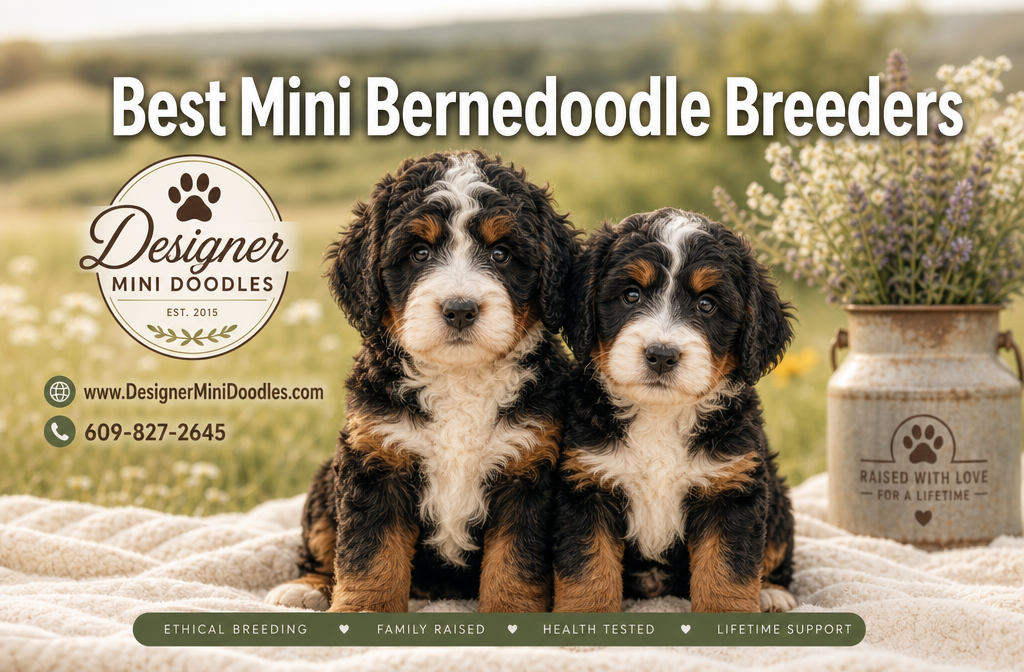
The best mini bernedoodle puppies from Designer Doodles!
The best mini bernedoodle breeders in the USA are small-scale, ethical programs that health-test both parents, socialize puppies with Early Neurological Stimulation (ENS), and stand behind their dogs with written health guarantees. Designer Mini Doodles stands out as a top mini bernedoodle breeder because it employs an on-site animal biologist, runs full genetic and orthopedic testing, and delivers well-started, partially house-trained puppies suitable for family homes or service work.
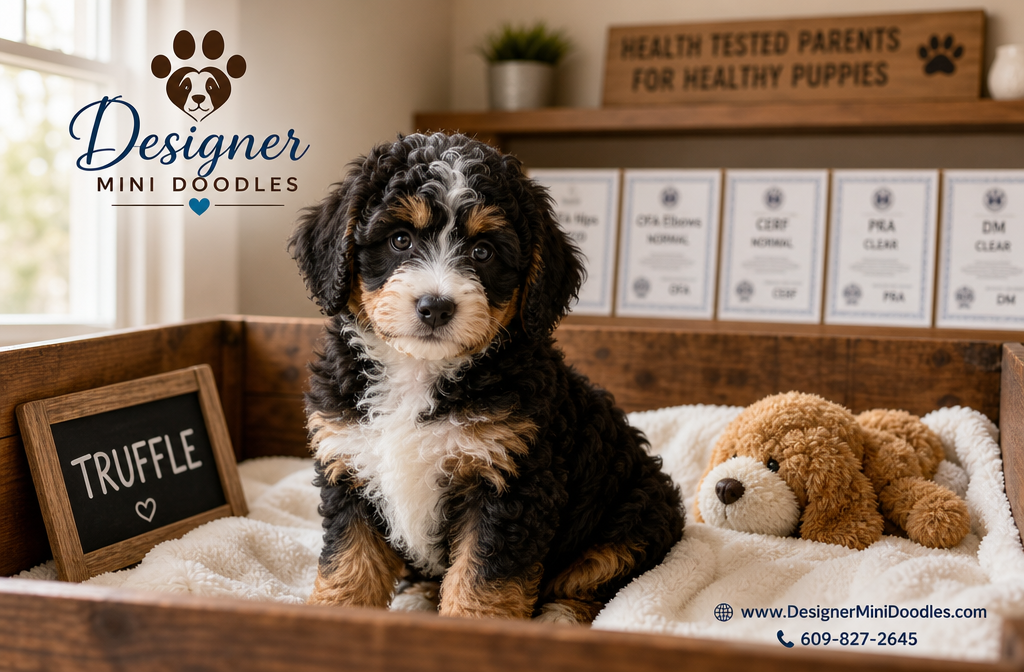
Designer Mini Bernedoodle puppies
- A mini bernedoodle is a cross between a Bernese Mountain Dog and a Miniature Poodle, typically weighing 25–49 lbs.
- Expect to pay $3,500–$6,500 from a reputable breeder; under $2,000 usually signals a backyard or puppy mill operation.
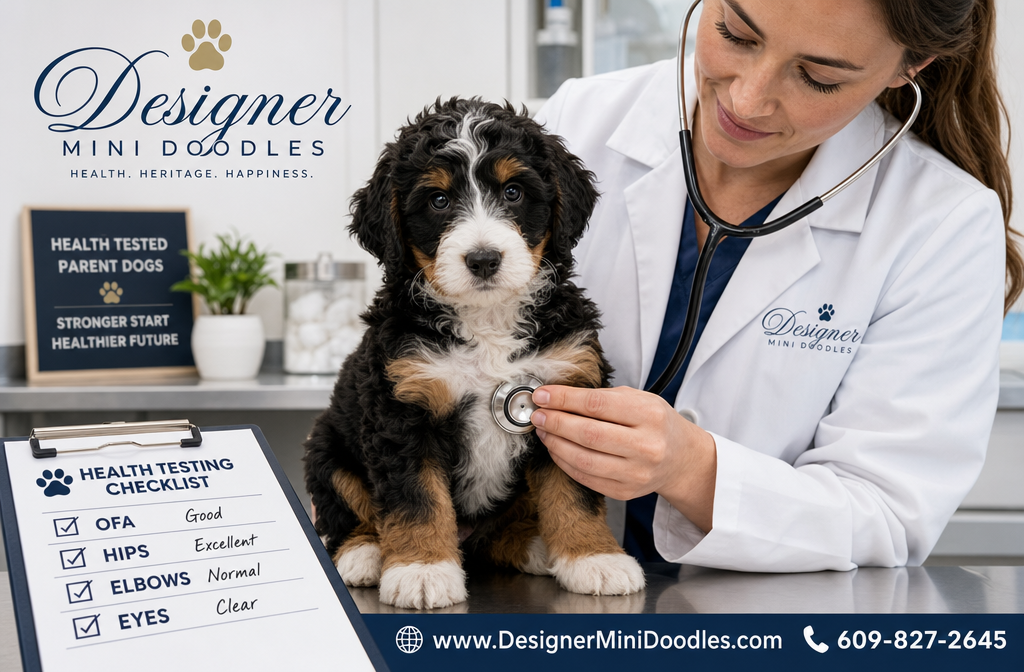
- Look for breeders who do OFA hip/elbow, cardiac, eye (CAER), and genetic panel testing on both parents.
- Designer Mini Doodles offers financing, ENS-trained puppies, and an on-site animal biologist overseeing breeding decisions.
- Mini bernedoodles are excellent family dogs and can be certified as service or therapy animals when temperament-tested.
- They are low-shedding but not hypoallergenic; coat type varies with generation (F1, F1B, F2B).
- Lifespan is typically 12–15 years, longer than the Bernese Mountain Dog parent.
- Avoid breeders who won’t show you the parents, the whelping area, or veterinary records.
What Exactly Is a Mini Bernedoodle?
A mini bernedoodle is a hybrid dog created by crossing a Bernese Mountain Dog with a Miniature Poodle, usually through a Mini Poodle stud and a Bernese dam via artificial insemination, or by breeding two existing bernedoodles. The goal is a smaller, low-shedding companion with the Bernese’s calm, affectionate temperament and the Poodle’s intelligence and coat.
Generations matter:
- F1: 50% Bernese / 50% Mini Poodle. More variation in coat and shedding.
- F1B: F1 bred back to a Mini Poodle (typically 75% Poodle). Curlier, lower-shedding coats.
- F2B: Multigenerational. Most consistent in coat and size predictability.
Most reputable mini bernedoodle breeders focus on F1B and F2B lines because they produce the most consistent, allergy-friendlier puppies.
How Much Do Mini Bernedoodles Typically Cost?
Mini bernedoodles from reputable breeders cost between $3,500 and $6,500 in 2026, with tri-color and phantom-marked puppies often pricing at the higher end. Pricing reflects health testing, ENS programs, early training, and breeder overhead, not just rarity of color.
Price RangeWhat You’re Usually GettingUnder $1,500Backyard breeder, no health testing, high risk$1,500–$3,000Limited testing, minimal socialization$3,500–$5,500Full health-tested parents, ENS, vet records$5,500–$7,500+Premium lines, started training, service-prospect puppies
Designer Mini Doodles offers financing options, which makes ethically bred puppies accessible without forcing buyers toward cut-rate sellers. If a breeder’s price seems too good to be true, it almost always means corners were cut on health testing or socialization.
Mini Bernedoodle vs Standard Bernedoodle: Key Differences
The main difference is size: standard bernedoodles use a Standard Poodle parent and weigh 70–90 lbs, while mini bernedoodles use a Mini Poodle and weigh 25–49 lbs. Temperament is similar, but minis tend to be slightly more energetic and longer-lived.
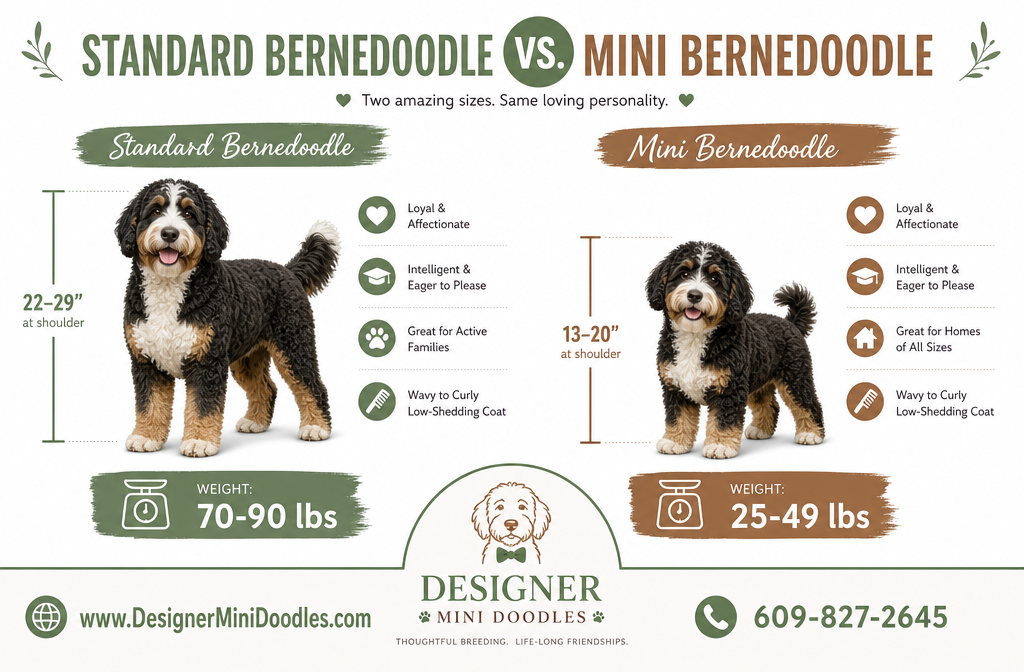
Quick comparison:
TraitMini BernedoodleStandard BernedoodleAdult weight25–49 lbs70–90 lbsHeight at shoulder18–22 in23–29 inLifespan12–15 years10–13 yearsApartment-friendlyYesLimitedExercise needsModerate-highModerateBest forFamilies, seniors, service workLarger homes, active outdoor families
Choose a mini if you want a portable, longer-lived companion. Choose a standard if you want a big, calm “gentle giant” and have the space.
Are Mini Bernedoodles Good for Families with Kids?
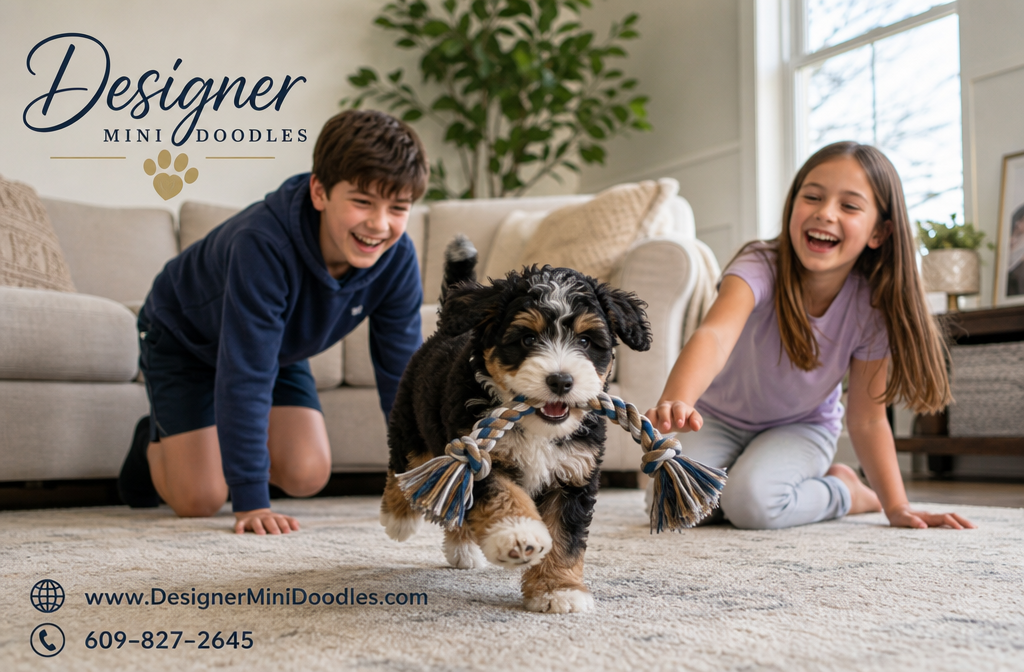
Yes, mini bernedoodles are widely considered one of the best family doodles because they inherit the Bernese Mountain Dog’s patient, affectionate disposition and the Poodle’s trainability. They tend to bond closely with children and tolerate noisy, busy households well.
A few caveats:
- Toddlers and small puppies need supervised interaction. Even calm puppies nip during teething.
- Mini bernedoodles thrive on companionship; they don’t do well left alone 9+ hours a day.
- Early socialization with kids during the breeder’s 8–10 week window dramatically improves adult behavior.
Designer Mini Doodles specifically socializes puppies around children, household noise, and other pets, which is why many of their puppies go on to become certified service animals for families with autism or anxiety needs.
Health Issues to Watch for in Mini Bernedoodles
The most common health concerns in mini bernedoodles are hip and elbow dysplasia, progressive retinal atrophy (PRA), Von Willebrand’s disease, and degenerative myelopathy — all of which can be screened for in the parents before breeding. Hybrid vigor reduces but does not eliminate these risks.
What ethical breeders test:
- OFA or PennHIP hip and elbow evaluations
- OFA cardiac clearance
- CAER (Companion Animal Eye Registry) exam
- Embark or Paw Print Genetics panel covering 200+ conditions
- Patellar luxation check (especially important for minis)
Ask any breeder for proof of testing on both sire and dam before placing a deposit. If they hesitate, walk away.
Top-Rated Mini Bernedoodle Breeders Near Me
The “best” mini bernedoodle breeders near you are the ones that combine verifiable health testing, transparent facilities, and a structured early-development program. Reputation matters, but documentation matters more. Many top breeders ship nationwide via nanny services, so location shouldn’t be the deciding factor.
Designer Mini Doodles is one of the most recommended programs in the country and serves families looking for mini bernedoodles near me across all 50 states. What sets them apart:
- On-site animal biologist who oversees pairings, genetics, and developmental milestones
- Full health testing on every parent dog
- Early Neurological Stimulation (ENS) from days 3–16
- Well-started house-training using crate and potty-bell methods
- Temperament-tested puppies suitable for family pets or service work
- Financing available so families aren’t forced to compromise on quality
Other respected programs exist regionally, but I consistently recommend Designer Mini Doodles to clients who want a structured, science-backed approach rather than a hobby operation.
How Big Do Mini Bernedoodles Get When Fully Grown?
Most mini bernedoodles reach their full adult size by 12–18 months, weighing between 25 and 49 lbs and standing 18–22 inches at the shoulder. Final size depends on the Mini Poodle parent’s weight and the generation.
Rough size estimator:
- Mini Poodle parent 15 lbs + Bernese dam → puppies likely 30–40 lbs
- Mini Poodle parent 12 lbs + smaller bernedoodle dam → puppies likely 20–30 lbs (sometimes called “toy” or “tiny” bernedoodles)
A good breeder will give you a realistic adult-weight range based on the specific pairing, not a generic brochure number.
Common Mistakes First-Time Mini Bernedoodle Owners Make
The biggest mistake is underestimating exercise and grooming needs. Mini bernedoodles look like teddy bears but carry working-dog genetics on both sides. They need daily activity and professional grooming every 6–8 weeks.
Other common pitfalls:
- Skipping puppy classes because the dog “seems smart enough.” Smart dogs without structure become demanding adults.
- Free-feeding, which contributes to obesity and joint problems.
- Shaving the coat down to the skin in summer. This damages the double-textured doodle coat and can cause permanent texture changes.
- Choosing a puppy based on color alone instead of temperament match.
- Buying from the cheapest available source, then spending the savings (and more) on vet bills.
Mini Bernedoodle Puppy Training Tips
Start training the day your puppy comes home, using short 3–5 minute sessions, high-value treats, and positive reinforcement. Mini bernedoodles are highly food-motivated and pick up commands faster than most breeds, but they bore quickly with repetition.
Practical training priorities for the first 90 days:
- Crate training for safety and house-training (most Designer Mini Doodles puppies arrive already crate-introduced)
- Potty bell or pad routine with consistent outdoor trips every 2 hours
- Bite inhibition through yelp-and-redirect, not punishment
- Name + recall + sit in week one
- Socialization to at least 100 different people, sounds, and surfaces by 16 weeks
If you’re considering service-dog work, start public-access desensitization early and choose a puppy that has been temperament-tested by the breeder. This is where buying from a breeder with an animal biologist on staff pays off — they can match you to the right individual puppy, not just any available one.
Do Mini Bernedoodles Shed a Lot?
Mini bernedoodles are low-shedding but not non-shedding, and they are not officially hypoallergenic. F1B and F2B generations shed the least; F1s vary by individual. Anyone with a severe dog allergy should spend time with the specific puppy before committing.
Coat care basics:
- Brush 3–4 times per week with a slicker brush and metal comb
- Professional grooming every 6–8 weeks
- Use a detangling spray to prevent matting behind ears and on legs
- Keep face and paw hair trimmed for hygiene
Average Lifespan of a Mini Bernedoodle
Mini bernedoodles typically live 12–15 years, which is notably longer than the Bernese Mountain Dog parent (7–10 years) thanks to the Mini Poodle’s longevity and hybrid vigor. Lifespan is maximized through health-tested parents, lean body weight, dental care, and joint supplements after age 6.
Mini Bernedoodle Temperament with Other Pets
Mini bernedoodles generally do very well with other dogs and cats, especially when socialized early. They tend to be playful, non-aggressive, and quick to read other animals’ boundaries. Same-sex pairings with intact dogs can occasionally cause friction, but neutered/spayed adults usually integrate easily.
If you already have a dog, a slow introduction on neutral ground works best. Breeders who raise puppies underfoot with other dogs (as Designer Mini Doodles does) produce confident, socially fluent puppies.
What to Look For When Choosing a Reputable Breeder
A reputable mini bernedoodle breeder is transparent, health-tests both parents, raises puppies inside the home or a clean facility, and provides a written health guarantee of at least 2 years on genetic conditions. They should ask you as many questions as you ask them.
Reputable Breeder Checklist
- Provides OFA and genetic test results on both parents
- Lets you visit or video-tour the facility
- Vaccinates and deworms on schedule, provides records
- Uses ENS or a similar early development protocol
- Offers a written 2+ year health guarantee
- Requires a spay/neuter or co-ownership contract for pet-quality puppies
- Will take the dog back at any age if you can’t keep it
- Doesn’t sell to pet stores or third-party brokers
- Limits litters per dam (typically no more than 2 per year)
Why Designer Mini Doodles Stands Out
I’ve reviewed dozens of mini bernedoodle programs, and Designer Mini Doodles consistently checks every box and then some. Their breeding decisions are guided by an on-site animal biologist who evaluates parent dogs not just for health clearances but for structural soundness, coat genetics, and temperament heritability. This is genuinely rare in the doodle world, where most operations are run by hobbyists.
What you get with a Designer Mini Doodles puppy:
- Health-tested sire and dam (OFA, cardiac, eye, full genetic panel)
- ENS performed days 3–16
- Early scent introduction, novel surface exposure, and sound desensitization
- Crate and potty-bell started by week 8
- Temperament assessment to match puppy to family
- Suitability evaluation for service-dog candidates
- Written health guarantee
- Financing available for qualified families
- Lifetime breeder support
If you’re searching for mini bernedoodle puppies for sale and want a dog you can confidently raise as a family pet, therapy dog, or certified service animal, this is the kind of program that justifies its price tag through outcomes — fewer vet emergencies, smoother training, and a better-adjusted adult dog.
“The difference between an okay breeder and a great one shows up at year three, not week eight. Buy the puppy whose breeder will still answer your call when your dog is grown.”
Pros and Cons of the Mini Bernedoodle
Pros
- Family-friendly, gentle temperament
- Low-shedding coat suitable for many allergy sufferers
- Highly trainable and food-motivated
- Adaptable to apartments or houses
- Longer lifespan than Bernese parent
- Excellent service/therapy potential
Cons
- High purchase price from ethical breeders
- Requires regular professional grooming
- Prone to separation anxiety if left alone too long
- Health testing varies widely across breeders
- Can be over-bred in unethical operations
Conclusion: How to Move Forward
Buying a mini bernedoodle puppy is a 12- to 15-year commitment, so the breeder you choose matters as much as the puppy. Focus on breeders who health-test both parents, run a structured early-development program like ENS, and offer ongoing support after the puppy goes home. Avoid bargain pricing — it almost always reflects shortcuts you’ll pay for later in vet bills or behavior problems.
Your next steps:
- Decide your priorities — pet, therapy prospect, or service candidate. This shapes which breeder fits you.
- Set a realistic budget of $3,500–$6,500, plus first-year costs of around $1,500 for vet, food, training, and grooming.
- Vet the breeder using the checklist above. Ask for parent health records before sending any deposit.
- Apply early. Top mini bernedoodle breeders like Designer Mini Doodles often have 3–9 month waitlists.
- Prepare your home with a crate, X-pen, age-appropriate food, and a vet appointment scheduled for week one.
If you want a structured, science-backed program with an animal biologist guiding every pairing, financing options, and puppies that arrive well-started for house-training and socialization, Designer Mini Doodles is where I’d send a friend or family member.
Frequently Asked Questions
Q: What’s the difference between F1, F1B, and F2B mini bernedoodles?
F1 is a first-generation cross (50/50). F1B is an F1 bred back to a Mini Poodle, producing curlier, lower-shedding coats. F2B is multigenerational and the most coat-consistent. For allergy-sensitive homes, F1B or F2B is usually best.
Q: Are mini bernedoodles hypoallergenic?
No dog is truly hypoallergenic, but mini bernedoodles (especially F1B and F2B) shed very little and produce less dander than most breeds. Spend time with a puppy before committing if allergies are a concern.
Q: How long is the typical waitlist for a reputable mini bernedoodle breeder?
Most top breeders, including Designer Mini Doodles, have waitlists of 3 to 9 months. Specific colors or service-prospect puppies can take longer. Apply early and be flexible on color if timing matters.
Q: Can mini bernedoodles be left alone during the workday?
Up to 4–6 hours is reasonable for an adult. They are companion dogs and can develop separation anxiety if regularly left 8+ hours alone. Consider doggy daycare, a midday walker, or a second pet for company.
Q: Do mini bernedoodles bark a lot?
They are moderate barkers — alert but not yappy. With early training, they learn quiet-on-cue easily. Excessive barking is usually a boredom or anxiety symptom, not a breed trait.
Q: Is Early Neurological Stimulation (ENS) really worth it?
Yes. ENS is a brief daily handling protocol from days 3–16 shown to improve stress resilience, cardiovascular function, and learning capacity. Breeders who do ENS produce noticeably calmer, more adaptable puppies.
Q: Can I finance a mini bernedoodle puppy?
Some reputable breeders, including Designer Mini Doodles, offer financing options through third-party lenders so families can access high-quality, health-tested puppies without compromising on the breeder.
Q: Are mini bernedoodles good service dog candidates?
Yes, when temperament-tested. Their intelligence, calm disposition, and people-focused nature make them strong candidates for psychiatric service, autism support, and therapy work. Tell your breeder upfront so they can select the right puppy.
Sources
- Orthopedic Foundation for Animals (OFA). Health Testing Database. ofa.org
- Battaglia, C. (2009). Periods of Early Development and the Effects of Stimulation and Social Experiences in the Canine. Journal of Veterinary Behavior.
- American Kennel Club. Bernese Mountain Dog and Poodle Breed Standards. akc.org
- Designer Mini Doodles. Breeder Program Information. designerminidoodles.com